Posts tagged diet

Quality versus Quantity Nutrition

Author- Mariam Lakdawala (Registered Dietician)

Common questions I generally get from my patients suffering from obesity,

I don’t eat much, still why am I gaining weight?”

“I eat less than one of my friend, but why is she so thin and I am not?”

My answer to such questions is simple, “Don’t only see how much is on your plate, but also see ‘what’ is on your plate”.

The basic rule of weight loss is to restrict the overall quantity of food and increase the calorie burning capacity of the body. However, this rule has been outdated as only quantity restriction in the absence of food quality management, will not result in positive weight loss outcomes. Also a good quality diet which consists of good quantities of proteins and fiber keeps you full for longer and delays the intake of subsequent meal.

Though factors like genetics and heredity play a major role in adding those kilograms, ‘food’ can also be a major factor for tipping the scales towards obesity. If the quality of the diet is poor, food becomes the major cause of obesity. Your food plate determines the quality of your meals. An ideal food plate must have all the major (macro) nutrients i.e. carbohydrates (also includes fiber), proteins and fats in correct proportions.
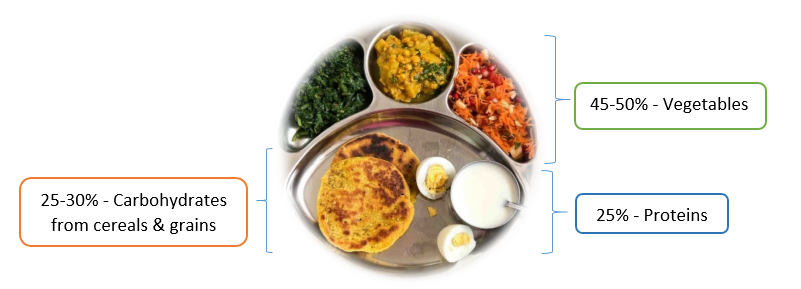
weight loss diet in mumbai, india

In India, our diet is rich in carbohydrates with very less quantities of vegetables and proteins. This has an adverse impact on our metabolism and exposes us to various metabolic diseases, including obesity. In metropolitan cities the dependence on ready to eat processed foods like biscuits, breads, noodles, sausages/ nuggets etc is much higher in order to save time. These processed foods are generally high in sugars, salt and fat which makes them less nutritious and dense with empty calories. Poor quality diet coupled with lack of physical activity just makes it worse and has played a big role in increasing obesity levels.

The quality and quantity of food are two sides of the same coin. Both the aspects are equally important not only for weight loss but also for maintaining good health and must not be ignored.

How can vegetarian patients keep up their protein intake post bariatric / weight loss surgery

Author: Mariam Lakdawala
Registered Dietician and Bariatric Nutritionist

Protein is very crucial as it forms a part of every cell, tissue and organ in the body. Post weight loss surgery meeting your ideal protein requirement is extremely important. All bariatric surgeries lead to restricted intake which in turn leads to a drastic decrease in the total number of calories consumed daily. In case of mal-absorptive bariatric surgeries, along with restriction the absorption of proteins is also affected. Indians are primarily vegetarian. Even those who consume non-vegetarian foods, do so in small quantities. Hence post bariatric surgery, it is extremely important to lay stress on this aspect of nutrition.

The major role of protein is to rebuild and maintain muscle mass. In addition, protein has many other roles to play, like it enhamces the wound healing post surgery, it enables the immune system to work efficiently, helps to maintain healthier hair, skin and nails and provides satiety which prevents hunger pangs in the subsequent meals.

Low caloric intake post-surgery, compels the body to use fat stores as well as muscle mass as a source of energy which results in the loss of lean muscle mass.

A daily protein intake of 1.5g/ Kg/ Ideal Body Weight has shown to prevent muscle loss (Moize. V. et. al., 2003). After bariatric surgery, for vegetarians, it is difficult to meet such high protein requirements through diet alone. Adding protein supplements to a high protein vegetarian diet thus becomes necessary to reach the ideal protein intake.

Dietary Management:

To keep up with the protein requirement of the body, the golden rule post weight loss surgery is to include a protein rich food in every meal. Let us have a look at few vegetarian foods rich in protein,

  • Low fat milk/ Low fat curds/ Unflavoured Yoghurt
  • Home-made Cottage cheese/ Tofu
  • Soymilk
  • Soy granules/ Soy chunks
  • Sprouts
  • Dals and Pulses
  • Combining dal/ pulse/ sprout with cereals (Rice/ Wheat/ Jowar/ Bajra/ Ragi/ Maize) in 1:1 proportion increases the quality of proteins.

You can incorporate one or more of these protein supplements listed below as prescribed by your Bariatric Nutritionist keeping in mind your requirements,

  • Protein powders – Whey isolate/ Whey Concentrate/ Other high protein blends (E.g. Soy + milk proteins/ Peanut + milk proteins, etc)
  • Protein bars
  • Protein chips
  • Threptin biscuits

Protein supplements are very important for atleast the first 10-12 months post the surgery. Later on, your intake increases fairly to meet the protein requirements through diet. Even after 1 year if protein rich foods are not consciously included in the diet, then continuing protein supplementation through external sources becomes unavoidable.

The compliance with protein supplements has always been poor due to its strong aftertaste, and food aversion post-surgery makes it even worse. However, with technological advancements the protein powders are getting better in terms of their taste and texture. There is a wide variety of flavours available in the market. In case you have tried many and still not being able to get your taste buds accustomed to it then you can try few tips to improve palatability,

  • Opt for vanilla flavour, as you can add some coffee powder/ fresh fruit to it for taste
  • Consume it chilled
  • Make it into a Smoothie by adding some yoghurt and fruit
  • You can add the protein powder to oat flour and make mini protein pancakes

What happens in case of protein insufficiency

Proteins play a very important role in the transport of various vitamins and minerals. Insufficient proteins in the body can affect the availability of vital nutrients such as iron, calcium, copper, and vitamins A & D.

Its insufficiency results in various symptoms like,

  • Edema/swelling,
  • fatigue,
  • muscle wasting,
  • thinning or brittle hair,
  • pale skin,
  • flaky or dry skin,
  • lethargy,
  • headache, etc.

Few suggestions to ensure sufficient protein intake are as follows, 

  • Don’t miss your follow-ups

Being regular with your follow-ups will help you to identify if you are deficient in protein

  • Maintain a diary

This option works great as you are aware how close or far you are from meeting your requirements. You just need to take out 10-15 minutes to write it down. End of the day is a good time to reflect and note down. Probably its even more effective than Almonds for improving your memory.

  • Maintain a checklist

You can consult your Bariatric Nutritionist to prepare a checklist of protein rich foods to be consumed daily as per your requirements. Put up that checklist in the kitchen so that you don’t forget your PROTEINS.

So please ensure that after bariatric surgery you are taking enough protein. If you are unable to do that, please get in touch with your bariatric nutritionist for her guidance. Prevention is always better than cure!

Reference

Moize, V., Geliebter, A., Gluck, M. E., Yahav, E., Lorence, M., Colarusso, T., … & Flancbaum, L. (2003). Obese patients have inadequate protein intake related to protein intolerance up to 1 year following Roux-en-Y gastric bypass. Obesity surgery, 13(1), 23-28.