Date Archives August 2019

YOU ONLY LIVE ONCE “YOLO” ??

-Dr. Aparna Govil Bhasker

I wake up every morning and without fail, spend atleast ten painstaking minutes standing in front of my wardrobe thinking what to wear. And every single day, for as many years as I can remember, I have been plagued by this one thought-

“I dont have enough clothes (translates to shoes, accessories, jewellary etc etc)!”

My husband ofcourse has a starkingly different opinion on this but I guess like all other husbands in successful marriages he has mastered the art of ignoring certain things. Works better that way ?!!

A shopaholic by my own confession, my dedication to shopping sometimes extends into 4.00 am shopping sprees at airports. For me it forms for a fabulous start to a great day ahead. I have this innate ability to be able to shop anywhere, anytime… Much to my husband’s chagrin, I still have no qualms about picking
up stuff from the local stores of Hill Road, junk jewellary from the Colaba causeway or footwear from the Linking road. I have the same zeal and dedication when I buy stuff from a village in Rajasthan or from a branded store in Mumbai. I love to bargain with local shop-keepers and to be honest I still haven’t gotten over the embarassing habit of looking discreetly at the price tags in the high end stores!

Just passing by a crowded market area is enough to elevate my mood. My mother often tells me that what I buy will not last me very long… and I am like, “Mom, that’s exactly why I bought it! I don’t want it to last too long!” Afterall, variety is the spice of life. I dont want to wear the same pair of shoes for 2 years.. I would rather have a new set every few months!

Since I started earning myself, I allocate a monthly budget exclusively for myself. Its not much but its enough to make me happy. I disagree with the common perception that happiness is difficult to find. Nothing elevates my mood more than finding something that I like. Shopping works like a drug for me! The world is cruel at times but the mall always has a healing effect! Lol!

As I grow older, I realize that pampering myself is an important aspect of life. An extra shade of lipstick, a new pair of earrings, an extra pair of shoes, one more book on my shelf or new cup for my coffee does wonders for me!

As women, pampering others comes more naturally to us than the other way round. Most of us have to work hard at learning to love ourselves. All I have to say is that there is only one life we all get… We all struggle for the big things in life, in the process don’t give up on the small pleasures (even if they are a little materialistic by worldly standards… lol). Ultimately happiness is not a goal that we will achieve one fine day in the future, it is a continuous phenomenon. It is a drug that we need on a daily basis, to go on.

All of us have that one thing that makes us happy, and the trick is to identify it. We all need our drug. Make an effort towards finding your drug and learn to pamper yourself a little sometimes, for life is short and you only live once (YOLO ??).

Dr. Aparna Govil Bhasker

Cadaver- A Surgeons First Teacher

Dr Aparna Govil Bhasker MS,

Bariatric and Laparoscopic Surgeon, Mumbai, India


The business of saving lives begins in the company of death. For most of us something changed the moment we walked into the anatomy dissection hall on the first day of our medical training. It is a surreal experience, frightening and fascinating at the same time. We spend the best decade of our lives to learn how to repair wounds, how to heal a body, how to make it whole again. On day one of our medical career the cadaver teaches us that we can only try our best and eventually there may be some wounds that we may not be able to repair and some bodies that we cannot heal. As it lies on the dissection table surrounded by a bevy of zealous and fervent medical students, a cadaver teaches us the first and the most important lesson that “Doctors are not God”.

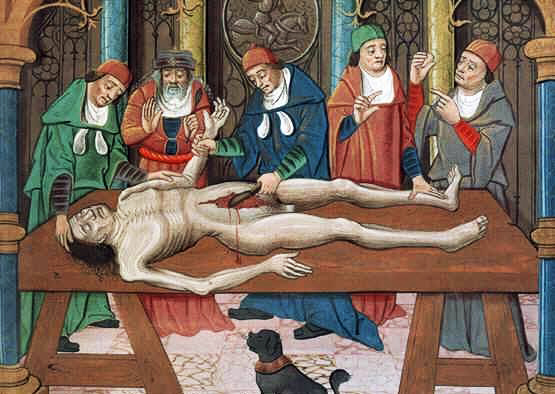
In the 3rd century BC, the city of Alexandria was home to two physicians- Herophilus and Erasistratus who defied the law and dissected human corpses to clear many misconceptions about the human body. They eventually fell into disrepute as reports of dissection by them on live prisoners started coming in. Although it was banned for centuries in many regions of the world, cadaver dissection has been integral to anatomical and surgical research. From Leonardo-da Vinci to Michael Angelo, many renowned artists attended dissections to understand nuances of the human body and went on to publish their drawings to add to the anatomical literature.

Surgical training is at a tipping point today. The advent of surgical simulators, computer modeling, animal and human dummies, free availability of surgical videos on platforms like you tube and other online libraries have provided training avenues like never before. Yet when a young surgeon wields the scalpel for the first time, his hands are shaky and that first cut invokes a combination of both dread and awe. No simulator or app can mimic the complexity of human anatomy and tissue fidelity.

Like most other branches of medicine, surgery is an ever evolving field. It is about learning the technique, practicing it and eventually mastering it. Every few years there is a paradigm shift and we as surgeons need to constantly update and upgrade ourselves with the newer technology. Most of us learn these techniques from the experts and eventually end up practicing on our unassuming patients. The process is not only unfair to our patients but is also painfully long and most of the times it takes years for a surgeon to be confident of her/his skillset. A surgeon has to be on her/his “A-Game” every time she/he walks into the operation theater and no other specialty in the medical profession demands as much precision and commitment as surgery. 

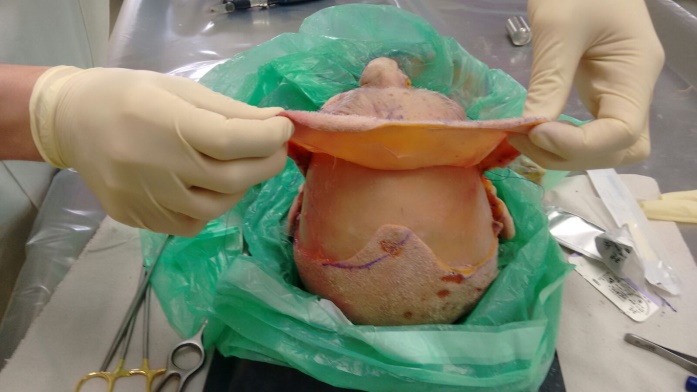
In the recent years cadaver labs have emerged as a useful and effective method for surgical training. Spatial perception of anatomy is one of the biggest advantages that a cadaver offers over any other training modality. It also helps surgeons to practice new techniques in a safe environment before performing on a live patient and cadaver training can benefit all surgeons from the trainee level to the more experienced consultants. In an ideal world, surgery training would probably include practicing surgical procedures on cadavers to become proficient before operating on live patients.

Unfortunately there is a perpetual shortage of cadavers in most parts of the world and body donation is a challenge almost everywhere. Most cadaver labs rely on unclaimed bodies and however gory it may sound, grave digging still thrives as a business in some places.

In a country like India, cultural and religious reasons prevent most people from donating their bodies for medical advancement. M S Ramaiah Institute in Bangalore was the first to start a cadaveric research and training unit in India. Recently Amrita institute of medical sciences in Kochi was the second Indian institute for initiating training courses on cadavers. Now we have a few more. However, the acceptance is very slow and these institutes constantly grapple with shortage of cadavers.

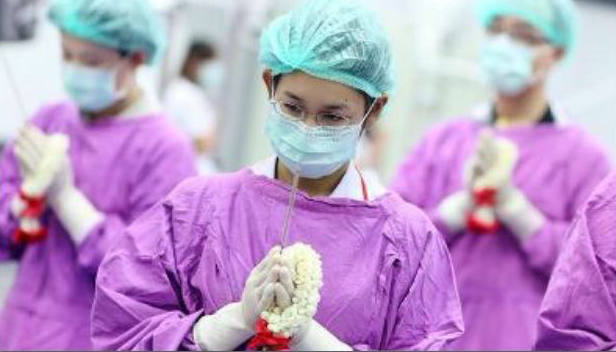
The east and the west have devised two very different approaches to tackle this issue of body donation. My first experience of a cadaver lab was at the Chula Surgical Training Center in Bangkok, Thailand set up in 2007 by Dr. Suthep Udomsawaengsup. Equipped with 48 state of the art working stations, multiple training workshops are conducted round the year at this lab.

Till 30 years ago, Thailand was struggling like any other country to acquire cadavers. Today most cadavers are acquired through voluntary un-remunerative donation. Body donation is considered as the highest form of donation. Not only is it approved by the King, donors are also bestowed with the highly regarded status of “ajarn yai” or the “great teacher”. Unlike the west which treats the cadaver as the “first patient” the east regards it as the “first teacher”. The other difference is that the west lays more focus on emotional coping and the east primarily focuses on forming a relationship with the new teacher. The west thrives on anonymity whereas in the eastern culture training starts with the introduction and life history of the cadaver that was once a person [1].

Medical University of Vienna is well known for its hands on courses on fascial aesthetic surgery and dental implant surgery on fresh cadavers. Unlike Asian countries, most European countries have an “opt out” program for organ and body donation.  Donation occurs automatically unless a specific request has been made prior to death. The “opt out” system works better 

for obvious reasons and the rate of organ and body donation is higher in countries that practice this system.  Hesitancy to discuss regarding their death, religious reasons and a gap between intent and action are the primary reasons for failure of the “opt in” system most of the times. 

Solo surgery time is a landmark day in the life of every surgical resident. We slog day and night, for that one moment when we would be allowed to operate on a patient independently. It’s a different high, to have another fellow being’s life in our hands, to be in total control. Great power comes with greater responsibility and what we cannot afford is………..to make a mistake. Errors in surgery can prove to be devastating for the patient as well as the surgeon. Training is the key to minimizing these errors and in future cadaver labs will play a significant role in surgical training. Surgery cannot be learnt from books alone and as the French anatomist Marie François Xavier Bichat once said- “Open up a few corpses: you will dissipate at once the darkness that observation alone could not dissipate”


References

  1. Andreas WinkelmannFritz H Güldner. Cadavers as teachers: the dissecting room experience in Thailand. 2004 Dec 18; 329(7480): 1455–1457.

Acknowledgements

  1. Dr Suthep Udomsawaengsup – King Chulalongkorn Memorial Hospital, Bangkok, Thailand
  2. Dr Ajjana Techagumpuch- King Chulalongkorn Memorial Hospital, Bangkok, Thailand
  3. Dr Debraj Shome – Breach candy and Saifee hospitals, Mumbai, India

WOMEN….. THE MOOLAH AND THE GENDER PAY GAP IN HEALTHCARE

Dr. Aparna Govil Bhasker

The other day I saw a tweet from United Nations about the gap in gender pay parity. “Worldover……women across professions, earn 20 to 30% less than men.”

It has been quite sometime and I just cannot get the figures out of my system. I googled the figures for pay parity in healthcare and there were no surprises there. Women in medicine can earn upto 37% lesser than their male colleagues .

Over the years, I have trained many young surgeons, while most of them were men, there were some young ladies as well. I will not talk about myself yet. That’s for later.

Well, all trainee surgeons are different but when I think hard, there were a few basic traits that seperated male trainees from the ladies. I may be biased, but the ladies were in general more sincere, more loyal, more punctual, more empathetic and better workers. The boys were good too, but the girls certainly scored over them. The girls were also more inclined to follow the rule book and accept dissent and criticism more wilfully.

When it came to surgeries, boys were certainly more proactive in asking the bosses to allow them to operate. And the ladies… well they patiently waited their turn. They would believe that they would be fairly rewarded for their sincere and hard work. They were less forthcoming and certainly not as vociferous as the boys. Well, surgery is one branch where the more hands-on you get, the better you become. No guesses here about who would eventually turn out to be more surgically skilled. Women would either get disgruntled with the system and leave or ended up spending much longer time to attain the same skills as men. And mind you …… this was not because they were bad surgeons, it was mainly because they never would ask!

In general, women hesitate to ask or assert. They rarely question when others make their decisions for them. They do not negotiate and tend to give in easily. Hence a lady doctor who may be more capable than her male colleagues may actually end up with much lesser on her plate.

Why do women do this? Taking my own example, I was uncomfortable around money matters. I tended to avoid financial discussions. I was happy if someone else did that on my behalf. In my entire career I only focused on work ethics and skill development, never gave much heed to finances. Well, these traits are not limited to me alone, I am sure that a lot of women will identify with me. Some of us actually take pride in our ignorance about financial issues and no wonder the gap in gender pay parity is ever increasing.

“The real issue here is that women are nurturers by nature. We tend to derive our value from being needed and not by being rewarded.”

While many times women are ignorant about what their colleagues are taking home, organizations are also not transparent about pay scales between employees. It is totally possible that the woman employee may be the most capable, appreciated or honoured in the workplace but her take home salary may not be at par with her male counterparts. Would she be aware of this disparity? Probably yes or may be not. Would she go back to the boss’s office to renegotiate? I think not. What we need to remember is that sometimes even “excellence” can be taken for granted and one may need to remind the organization about its value from time to time.

I have also come across a few lady doctors who were more assertive and did not hesitate to call a spade as a spade. What do we think about them? Honest confession, at times I have myself labelled those women as being too pushy or bossy! Too forthcoming… is what I would think of them! Would I think the same way about a male colleague with similar traits? Probably not. This is where the problem lies. Even women themselves dont think kindly about other women who are more assertive. Somewhere we like being the underdog! Do women bosses play a fair game when it comes to them? I don’t have the answer to that.

Ofcourse, we need better work place policies, we need more understanding bosses and there is a need to empower women. But most of all what we need to change is, ourselves. We need to introspect take charge and be more assertive. We have to learn to value ourselves before we expect others to value us. We need to stop cringing from financial discussions and have to understand that money is not evil. It is just a way to value our expertise. By accepting less, we undervalue ourselves. The gap in gender pay parity may not fill in the near future but we need to start somewhere and that place is within us.

Because ultimately we need to be the change that we want to see in the world.

– Dr. Aparna Govil Bhasker is a bariatric and Laparoscopic surgeon.